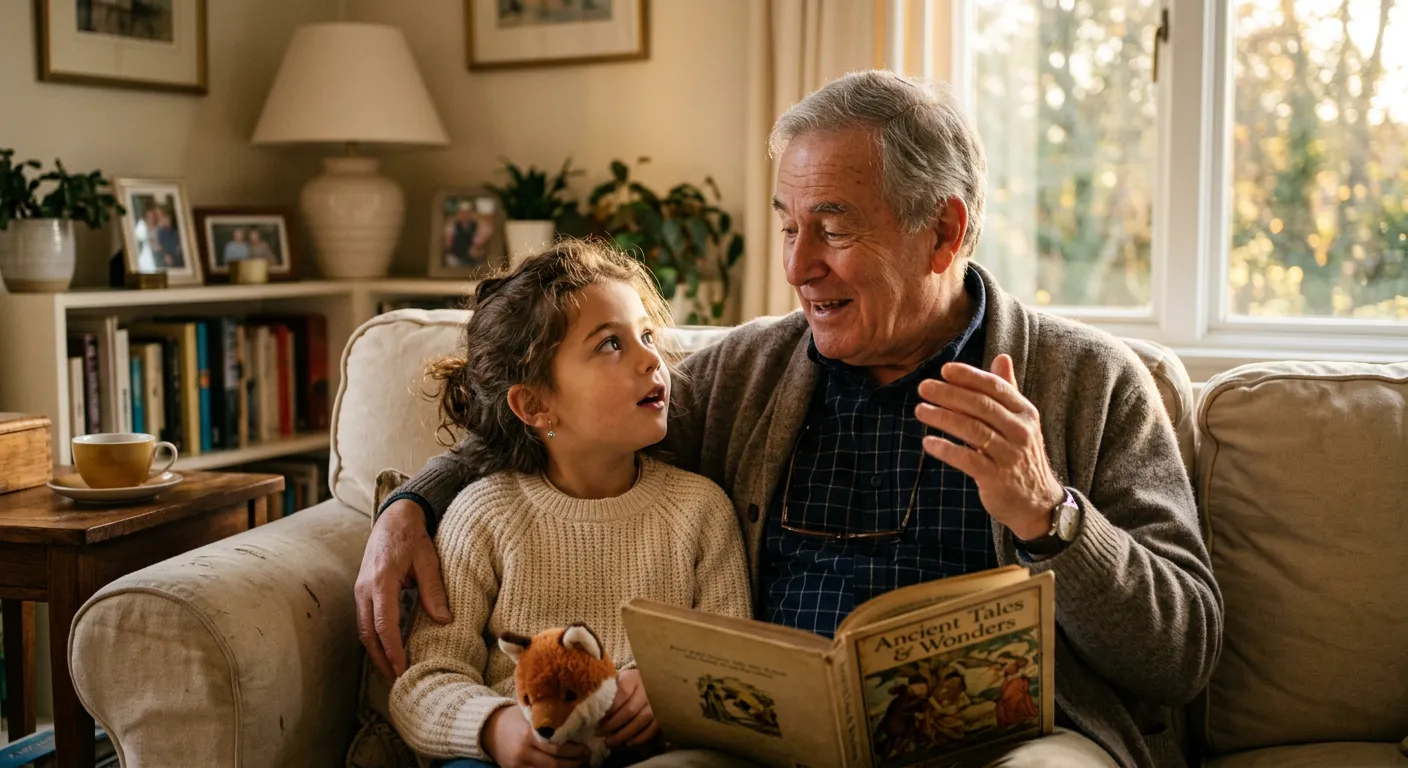
Your daughter comes home from school, upset. A friend said something hurtful, and she's questioning whether she fits in. You sit beside her, and instead of offering advice, you tell her a story. About her grandmother, who moved to a new country at age twelve without speaking the language. Who was teased mercilessly. Who made her first friend by sharing a drawing she'd made of the teacher's cat.
Your daughter listens. Her shoulders relax. She asks questions. By bedtime, she's not just feeling better - she's feeling braver.
This isn't a parenting hack. It's science.

The Research That Changed Everything
In 2001, psychologists Dr. Marshall Duke and Dr. Robyn Fivush at Emory University developed something called the "Do You Know?" scale - a set of 20 questions designed to measure how much children know about their family history.
Questions like:
- Do you know where your grandparents grew up?
- Do you know some of the jobs your parents had when they were young?
- Do you know the story of your birth?
- Do you know about a lesson that your parents learned from their experience?
What they found was striking. Children who scored higher on the "Do You Know?" scale showed higher self-esteem, lower anxiety, fewer behavioral problems, and a stronger sense of control over their lives.
These weren't marginal differences. The "Do You Know?" scale turned out to be the single best predictor of a child's emotional health and happiness.
Why Family Stories Build Resilience
The connection between family stories and resilience isn't accidental. It works through several powerful mechanisms.
1. The Intergenerational Self
Dr. Duke calls it the "intergenerational self" - the sense that you belong to something bigger than yourself. When children know their family history, they don't see themselves as isolated individuals. They see themselves as part of a story that stretches back generations.
This matters because when children face challenges, their frame of reference expands. It's not just "I'm struggling." It's "My grandmother struggled too, and she got through it."
The shift from "I" to "we" is protective. It provides a psychological safety net that isolated children don't have.

2. Narrative Identity
Psychologists have long known that the stories we tell ourselves shape who we become. For children, family stories provide a template for narrative identity - a framework for understanding their own lives.
When a child hears about how their father failed his first driving test but persisted and eventually became a truck driver, they learn that failure isn't the end of the story. When they hear about their great-aunt who started a business during the Depression, they learn that obstacles can be overcome.
These stories become internalized scripts the child draws on when facing their own challenges.
3. Emotional Vocabulary
Family stories expose children to a range of emotions - joy, grief, fear, triumph, loss, love - in a safe context. They learn that difficult emotions are normal, survivable, and part of every life.
This emotional vocabulary helps children name their own feelings, process difficult experiences, and communicate about what's happening inside them.
4. Belonging and Identity
Every child asks, in some form: "Who am I? Where do I belong?" Family stories answer these questions directly.
They provide cultural identity - traditions, values, and heritage. Geographic roots - where your family came from and why. Character traits - "You get your stubbornness from your grandfather." And a sense of continuity - feeling connected to past and future.
The Three Types of Family Narratives
Dr. Duke and Dr. Fivush identified three types of family narratives:
The Ascending Narrative
"We had nothing, and through hard work, we built a good life."
This narrative inspires but can create pressure. If the family story is only about success, children may fear they'll be the ones to "break the streak."
The Descending Narrative
"We used to have it all, but then things fell apart."
This narrative can foster hopelessness if it's the dominant story. Children may feel trapped by circumstances.
The Oscillating Narrative
"We've had our ups and downs. We lost the house, but we stuck together. Your uncle got sick, but the family rallied around him. We've been through hard times, and we've always come through."
The oscillating narrative is the most powerful. It teaches children that life has good times and bad times, that challenges are normal, that the family persists through difficulty, and that they are part of a resilient group.

How to Share Family Stories With Your Children
Knowing that family stories matter is one thing. Actually sharing them is another. Here's how to make it happen.
Start With Everyday Moments
You don't need a formal storytelling session. The best opportunities arise naturally.
- At dinner: "This recipe reminds me of when your grandmother..."
- During a drive: "We're passing the neighborhood where I grew up. Did I ever tell you about..."
- At bedtime: "Instead of a book tonight, let me tell you a real story about our family."
- During holidays: "Let me tell you why we started this tradition..."
Match Stories to Moments
When your child faces a challenge, share a relevant family story. If they're scared of a new school, you can tell them about when their parent was the new kid. If they failed a test, share about a family member who struggled academically but found their path. If they're fighting with a friend, tell them about family relationships that weathered conflict.
The key is relevance - the right story at the right moment.
Include the Hard Parts
It's tempting to share only happy stories. But research shows that stories including struggle are more valuable. They normalize difficulty. They demonstrate coping strategies. They show that your family has survived hard times. And they give children permission to struggle without shame.
Make It Interactive
Don't just lecture. Make storytelling a conversation.
Ask your child what they think the person felt. Ask what they would have done. Let them ask questions. Invite them to retell the story later.
When children participate in the story, they internalize it more deeply.

The Grandparent Connection
Grandparents are uniquely positioned to share family stories.
Why grandparents are storytelling gold. They have the longest view of family history. They're often more patient and less rushed than parents. Children view them as wise and authoritative. The grandparent-grandchild bond is built for storytelling.
The challenge. Grandparents and grandchildren often don't live in the same city. Busy schedules limit visits. Grandparents may not know which stories to share. And the window of opportunity is limited.
Solutions. Regular phone or video calls focused on storytelling. Grandparent-authored books or journals. Voice recordings that capture not just words but tone, emotion, and personality. Family reunions with intentional story-sharing time.
What the Science Says: Key Research Findings
Here's a summary of the research supporting the power of family stories.
Emory University (Duke & Fivush, 2001). Children who knew more family history showed higher self-esteem, lower anxiety, and greater resilience.
Post-9/11 Follow-Up (Duke & Fivush, 2003). After September 11th, children who knew their family history recovered faster from the stress and anxiety.
Adolescent Studies. Teenagers with strong family narrative knowledge showed better emotional regulation, stronger identity formation, and healthier peer relationships.
Cross-Cultural Research. The benefits of family storytelling appear across cultures, socioeconomic levels, and family structures.

Practical Ways to Build Your Family's Story Library
For Parents
Create a family timeline. Work with your parents to document key events, dates, and stories.
Record conversations. Use your phone to capture grandparents sharing stories during visits or calls.
Build a story collection. Write down stories as you hear them. Date them. Note who told them.
Integrate stories into routines. Make "family story time" a regular part of your week.
For Grandparents
Start a story journal. Write one story per week. Include the facts AND the feelings.
Record voice messages. Your grandchild wants to hear YOUR voice telling the story, not just the words.
Create a memory box. Photos, letters, and objects that connect to stories you've shared.
For the Whole Family
Family interview nights. Take turns being the "interviewer" and "storyteller."
Photo album sessions. Old photos are powerful story triggers.
Cooking together. Recipes carry stories. Make a family recipe and share its history.
Road trips to meaningful places. Visit the house where Grandma grew up, the church where your parents married, the school where it all began.
The Cost of Not Sharing
Every day, stories disappear. A grandparent who doesn't share their stories takes those stories with them. A parent too busy to tell family tales creates children without roots. A family without shared narrative lacks the resilience that comes from knowing their history.
The cost isn't just sentimental. It's measurable in children's self-esteem, anxiety levels, and ability to cope with adversity.
Start Today
You don't need a perfect plan. You don't need special equipment. You don't need hours of free time. You need one story. Tell it tonight at dinner. Share it on the drive to school. Text it to your child with "Did you know this about our family?"
One story becomes two. Two become a collection. A collection becomes a legacy.
Your child doesn't just need to know where they came from. They need to feel it. And stories are how we feel our way into belonging.
Ready to save your family's stories?
Start recording today. It only takes a few minutes.
Start for free